


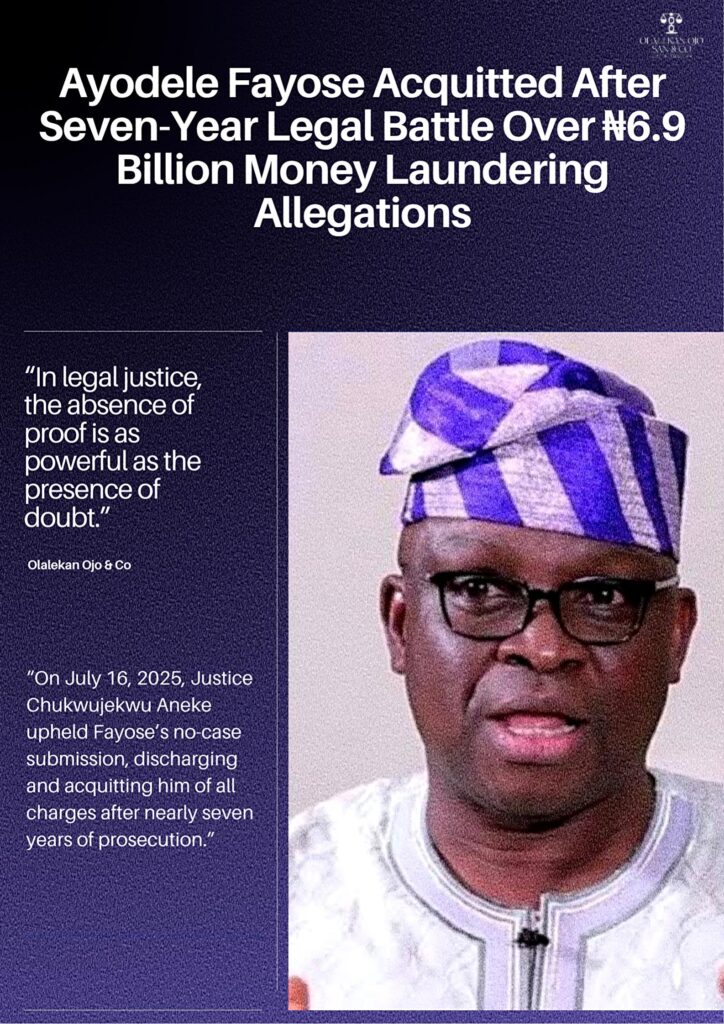
On July 16, 2025, Justice Chukwujekwu Aneke of the Federal High Court in Ikoyi, Lagos, ruled in favour of former Ekiti State Governor Ayodele Fayose, upholding his no-case submission and discharging him of all charges brought by the Economic and Financial Crimes Commission (EFCC) in a ₦6.9 billion fraud and money laundering case.
Fayose’s legal ordeal began on October 22, 2018, when he and his company, Spotless Investment Limited, were arraigned before Justice Mojisola Olatoregun on an 11-count charge. The EFCC accused him of receiving illicit campaign funds, engaging in illegal cash transfers, and laundering public funds through a network of shell companies to acquire properties in Lagos and Abuja. Following the reassignment of the case, proceedings resumed on July 2, 2019, before Justice Aneke.
In delivering his judgment, Justice Aneke stated that the EFCC had failed to provide sufficient evidence linking Fayose to any of the alleged criminal transactions. The court held that the prosecution’s case did not establish a prima facie case—meaning that there was no legally adequate reason to require Fayose to enter a defence. As a result, the court upheld the no-case submission and barred the EFCC from calling further witnesses or tendering additional evidence, effectively ending the trial at the lower court.
Olalekan Ojo SAN, counsel for Spotless Investment Limited (the second defendant), supported the no-case submission by stressing that the prosecution had failed to demonstrate a predicate offence, a necessary element for the money laundering charges to stand.
Shortly after the ruling, the EFCC expressed its intent to appeal the judgment, announcing that it was reviewing the decision and preparing to challenge it at the Court of Appeal.
This judgment marks a significant moment in a legal battle that has stretched nearly seven years. More broadly, it underscores the importance of no-case submissions within Nigeria’s criminal justice system—reminding both prosecutors and the public that when the prosecution cannot establish even a basic case, a defendant is under no obligation to present a defence.


